OPC, PPC or PSC: Choosing the Right Cement Grade
Three grades, three very different jobs. A practical guide to what each one is engineered for, and the costly mistake of choosing on price alone.
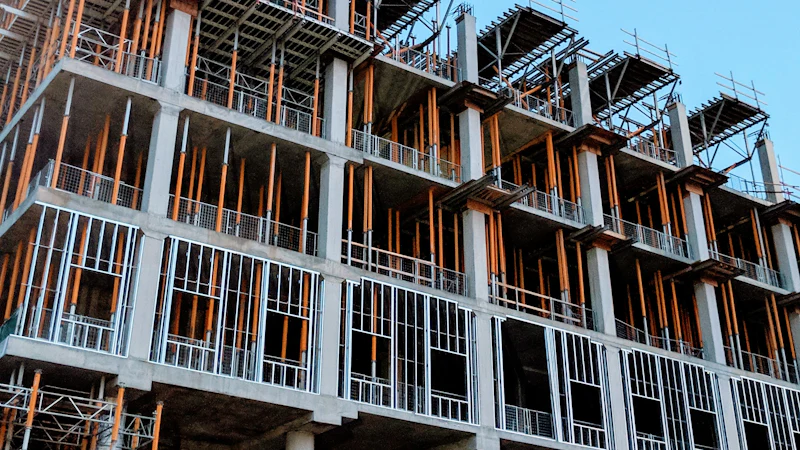
Walk onto most residential sites in India and you will find one cement being used for everything — foundations, columns, slabs, plaster, and the boundary wall. It works, in the sense that the building stands. But it is rarely the most durable or the most economical choice, and on structures exposed to sulphates or seawater it can shorten service life by decades.
The three grades in common supply — OPC, PPC and PSC — are not tiers of quality. They are different materials, designed for different exposure conditions and different strength curves.
Ordinary Portland Cement (OPC)
Governed by IS 269, OPC is essentially ground clinker and gypsum. It hydrates quickly, which means it develops compressive strength fast. That speed is the whole point: it lets a contractor strike formwork sooner and move to the next floor, which on a high-rise is the difference between an eight-day and a twelve-day cycle.
The trade-off is heat. Rapid hydration releases heat, and in a thick pour that heat cannot escape fast enough. The core expands while the surface cools and contracts, and the result is thermal cracking. OPC also offers less resistance to chemical attack than blended cements, because the free lime it releases during hydration is exactly what sulphates and chlorides go after.
Use OPC where early strength earns its keep — structural RCC, precast, prestressed elements, and fast formwork cycles. Not because it is the 'strongest'.
Portland Pozzolana Cement (PPC)
PPC (IS 1489) replaces a portion of the clinker with fly ash. The fly ash reacts with the free lime that OPC leaves behind, converting it into additional binding compounds. Three things follow from that single chemical fact.
- The concrete becomes denser and less permeable, because the reaction fills the capillary pores water would otherwise travel through.
- Chemical resistance improves, since the free lime that sulphates attack has largely been consumed.
- Heat of hydration drops, making PPC the safer choice for mass pours such as rafts and thick footings.
PPC gains strength more slowly than OPC in the first week, then keeps gaining well past 28 days — often overtaking OPC at 90 days. It is also more workable and finishes better, which is why it is the sensible default for plaster, masonry and general residential construction. And because fly ash displaces clinker, each tonne carries a materially lower carbon footprint.
Portland Slag Cement (PSC)
PSC (IS 455) substitutes granulated blast-furnace slag for part of the clinker, often at much higher replacement levels than PPC's fly ash. It is the grade you specify when the environment is actively hostile: seawater, sewage, effluent, or soil carrying sulphates. Its resistance to chloride ingress is what protects embedded reinforcement from corroding — the single most common cause of premature failure in coastal concrete.
The economics of getting it wrong
The price spread between these grades is narrow. The cost of specifying the wrong one is not. A sulphate-exposed foundation cast in OPC may show distress within a decade; remediation costs an order of magnitude more than the cement ever did. Conversely, paying for 53-grade OPC on a residential boundary wall buys nothing at all, and the higher shrinkage can crack the render if curing is careless.
The rule is simple: follow the structural engineer's specification. Where there is no specification, match the grade to the exposure condition, not to the number on the bag. If you are unsure which grade a job calls for, our technical team is happy to talk it through — it is a five-minute conversation that regularly saves years of service life.